
More Than One Language, More Than One Home
Reflections on bilingualism, identity, culture, and finding confidence in our voices
Being bilingual is not simply knowing two languages.It is learning to organize memories, emotions, relationships, and identity through multiple cultural frameworks. It is knowing that some words carry meanings that cannot quite be translated. It is realizing that certain memories arrive in one language and certain emotions in another.Sometimes, it is even noticing that we become slightly different versions of ourselves depending on the language we are speaking.For many years, I thought about bilingualism primarily as a skill. I spoke Spanish. I spoke English. One language belonged more naturally to certain spaces in my life, while the other became increasingly important in others.But the more I have reflected on language, culture, immigration, and identity, the more I have come to understand bilingualism as something much deeper.Language does not simply help us communicate.Language becomes part of how we experience ourselves.
More Than Two Languages in One Person
François Grosjean's Bilingual: Life and Reality challenged some of the assumptions I had carried about what it means to be bilingual.One of Grosjean's important ideas is that bilingual people should not be understood as two monolingual people existing inside one person.That distinction matters.We often measure bilingual people against monolingual standards. How perfectly do you speak each language? How large is your vocabulary? Do you have an accent? Can you communicate equally well in every environment?But bilingualism doesn't necessarily work that way.Grosjean describes what he calls the Complementarity Principle: bilingual people often acquire and use their languages for different purposes, with different people, and in different areas of their lives.One language may dominate at home.Another may become the language of school or work.One might hold childhood memories, family stories, humor, music, food, affection, or grief.Another might become associated with education, professional identity, leadership, problem-solving, or the life we built later.That does not make one language more complete or more valuable than the other.Together, they make up the bilingual person.When Different Languages Hold Different Parts of Us
There are things I can express more naturally in Spanish.There are other things that come to me first in English.Sometimes a memory feels almost inseparable from the language in which I experienced it.And sometimes translating something technically communicates the meaning while still losing something along the way.A joke isn't quite as funny.An expression doesn't carry the same weight.A term of endearment feels different.An emotion sounds almost too clinical once translated.This is one of the beautiful complexities of bilingualism.Our languages can become connected to different relationships, developmental periods, environments, and versions of ourselves.Neither version is more authentic.They are simply different expressions of the same person.And perhaps becoming comfortable with bilingual identity means learning that we don't have to choose between them.Language, Culture, and Belonging
Language becomes even more complicated when migration is part of the story.For children and adolescents especially, language can quickly become connected to questions of belonging.Which language should I speak here?Do I sound different?Am I American enough?Am I still connected enough to where my family came from?Why don't I know the word for something I understand perfectly?Why does my Spanish sound different from someone else's Spanish?Why do I feel embarrassed when my family speaks differently?Does having an accent mean I belong less?These questions may appear to be about language, but underneath them are often much larger questions:Where do I belong?Who am I allowed to become?For people who grow up across cultures, identity does not always fit neatly into one category. We may carry the country where we were born, the culture of our parents, the places where we were raised, and the communities that shaped us later.Integration does not require choosing one and abandoning the others.We can carry all of them.Our identities are not divided by the languages we speak.They are expanded by them.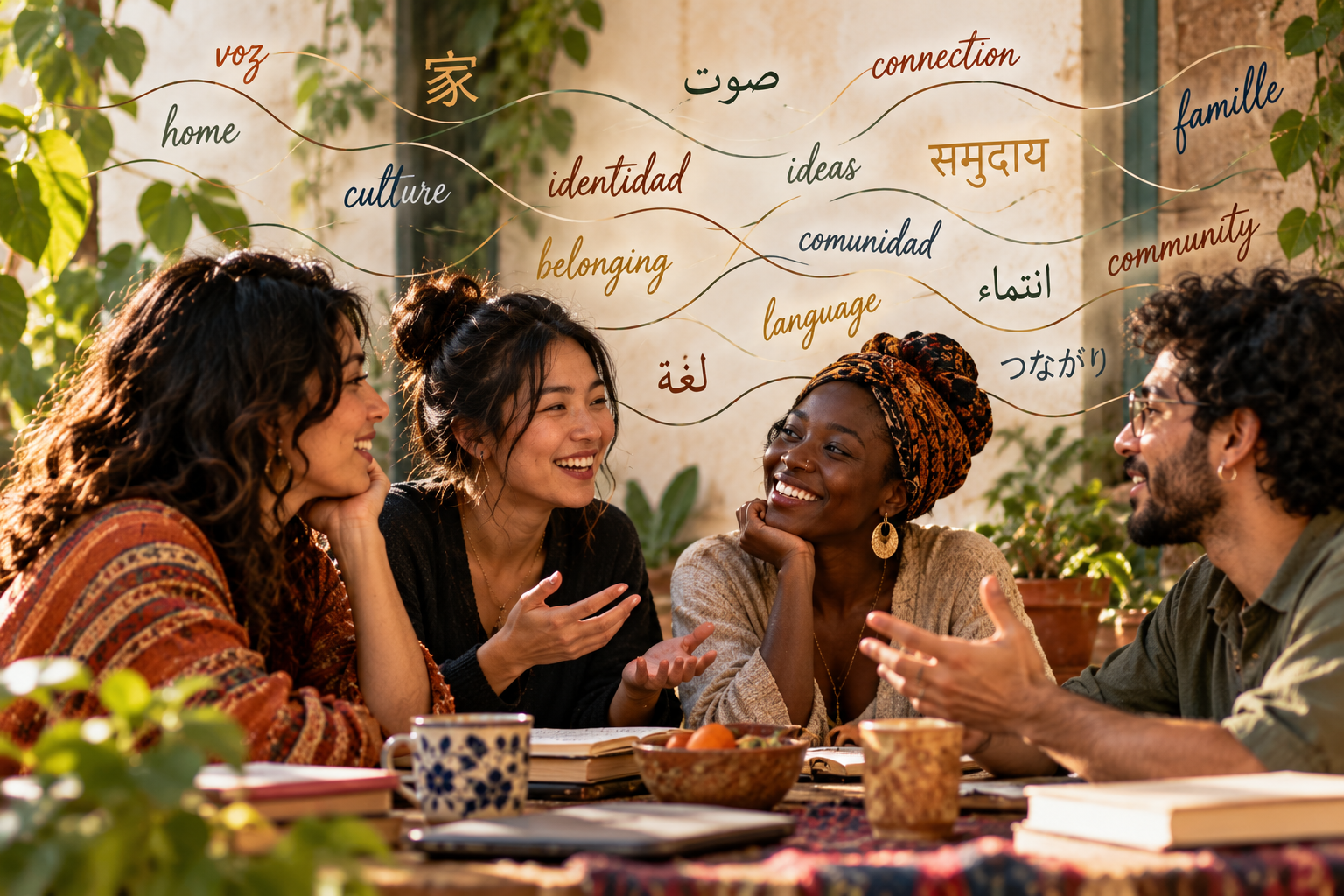
And Then There Is the Accent
There is another part of bilingualism that deserves acknowledgment.The vulnerability of speaking in a language in which we do not always feel effortless.An accent can make us suddenly aware of ourselves.We may begin monitoring how we pronounce certain words. We may rehearse something before saying it. We may wonder whether we sound professional enough, articulate enough, educated enough, or intelligent enough.And sometimes those fears aren't simply insecurity.People can make assumptions about competence, education, credibility, and intelligence based on the way another person speaks.That is worth naming.Because an accent is not a measure of intelligence.An accent tells a story.It can tell us something about where a person grew up, which sounds their brain learned first, where they have lived, or the languages and cultures that have shaped them.And sometimes an accent tells us something else entirely:The person speaking to you learned another language.Think about the complexity contained within that.A bilingual or multilingual person may be listening in one language while navigating cultural context, retrieving vocabulary, interpreting meaning, organizing a response, and communicating; all within seconds.What we sometimes hear as an imperfection may actually be evidence of extraordinary adaptation.Perhaps the question, then, shouldn't be how successfully someone has eliminated an accent.Perhaps we should question why we have learned to associate particular ways of speaking with intelligence in the first place. Please sit with that!Intelligence Has No Accent
There is a difference between language proficiency and intelligence.Knowing fewer words in a second language does not mean having fewer thoughts.Taking an extra second to find a word does not mean understanding less.Mispronouncing something does not make an idea less sophisticated.And speaking with an accent does not tell us how educated, insightful, capable, or intelligent someone is.Sometimes the person struggling to find a word in front of you could explain the same idea beautifully in another language.That is something worth remembering.Intelligence is universal. Opportunity is not.Our educational experiences, exposure to language, migration histories, socioeconomic circumstances, and opportunities to practice all influence how confidently we communicate.None of those things provide a reliable measurement of the mind behind the voice.Finding Confidence in Our Voices
Perhaps part of becoming comfortable in a bilingual identity is letting go of the expectation that fluency must mean perfection.You may search for a word.You may occasionally translate something directly and realize it doesn't quite work.Your accent may become stronger when you're tired, emotional, nervous, or surrounded by people who speak your first language.You may speak differently with your family than you do professionally.You may dream in one language and work in another.You may even find yourself saying something that begins in one language and ends in another because somehow that is the only way the thought feels complete.None of that makes you less articulate.It makes you bilingual.Confidence may not come from finally sounding as though we have only ever belonged to one place.Perhaps it comes from no longer believing that we need to.More Than One Home
The more I understand bilingualism, the less interested I become in the idea of choosing which language -or which cultural version of ourselves- is the "real" one.Maybe there isn't one.Maybe identity is not something we have to simplify in order for it to make sense.We can belong to the language of our childhood and the language in which we built our adulthood.We can carry memories from one country while creating a life somewhere else.We can love expressions that cannot be translated.We can have accents.We can forget words.We can move between cultures.We can continue learning.And we can allow all of those experiences to belong to the same person.Being bilingual is more than speaking two languages.It is carrying more than one way of understanding the world.More than one cultural rhythm.More than one collection of memories.Sometimes, more than one version of home.And perhaps the goal was never to choose between them.Perhaps it is learning to recognize the wholeness created by carrying them all.Reference
Grosjean, F. (2010). Bilingual: Life and Reality. Harvard University Press.