
Reflections on grief, death, spirituality, and the questions we cannot always answer

Miracles Happen workshop with Dr. Brian Weiss, Omega Institute, July 2026.
Recently, I attended a three-day workshop with Dr. Brian Weiss, a psychiatrist and author whose work explores past-life regression, reincarnation, meditation, and the possibility that consciousness continues beyond physical death.
I went into the experience with curiosity.
And perhaps curiosity is the most important word here.
We do not have to believe everything we encounter in order to explore it. We don't have to abandon psychology, science, religion, or our existing understanding of the world to wonder whether there might be aspects of consciousness, meaning, life, and death that we do not fully understand.
There can be value in the space between believing and knowing.
Our Relationship With Death
Death is one of the few experiences that will touch every human life, yet it remains remarkably difficult for many of us to talk about.
We fear our own death. We fear losing the people we love. And when someone dies, grief often confronts us not only with their absence, but with questions that have followed human beings for generations.
Where did they go?
What happens after we die?
Does some part of us continue?
Will I ever experience this person again?
And what does their death mean for the life I still have to live?
Weiss offers one particular spiritual framework for considering these questions. Across his work, he writes about reincarnation, past lives, the continuation of consciousness, and regression as a potential avenue toward healing.
Whether we understand those ideas literally, symbolically, spiritually, psychologically, or remain entirely uncertain about them, there is another question I find even more interesting:
What happens while we are alive when we become willing to contemplate death?
Grief and Continuing Connection
Grief is not simply learning how to live without someone.
It can also involve discovering what our relationship with that person becomes when they are no longer physically present.
There is a passage by Canon Henry Scott Holland that begins, “Death is nothing at all.”
Those words are often shared as a comforting reflection on death, although they originally appeared within a much larger 1910 sermon called The King of Terrors. In the full sermon, Holland doesn't simply dismiss the pain of death. He wrestles with two seemingly contradictory experiences: the horror and rupture of losing someone and the sense that something about our relationship with them continues. Taylor & Francis Online
I am drawn to that tension.
Because death is not nothing.
Loss can change us.
Grief can be devastating.
And still, many of us experience a sense of continuity with the people we have lost.
We remember conversations. We hear their voices in our minds. We dream about them. A song suddenly brings them close. We recognize pieces of them in ourselves.
Sometimes we experience what we might call coincidences, or perhaps synchronicities: moments, encounters, or patterns that seem to carry a significance beyond the event itself.
Perhaps continuing connection does not require us to deny the reality of death.
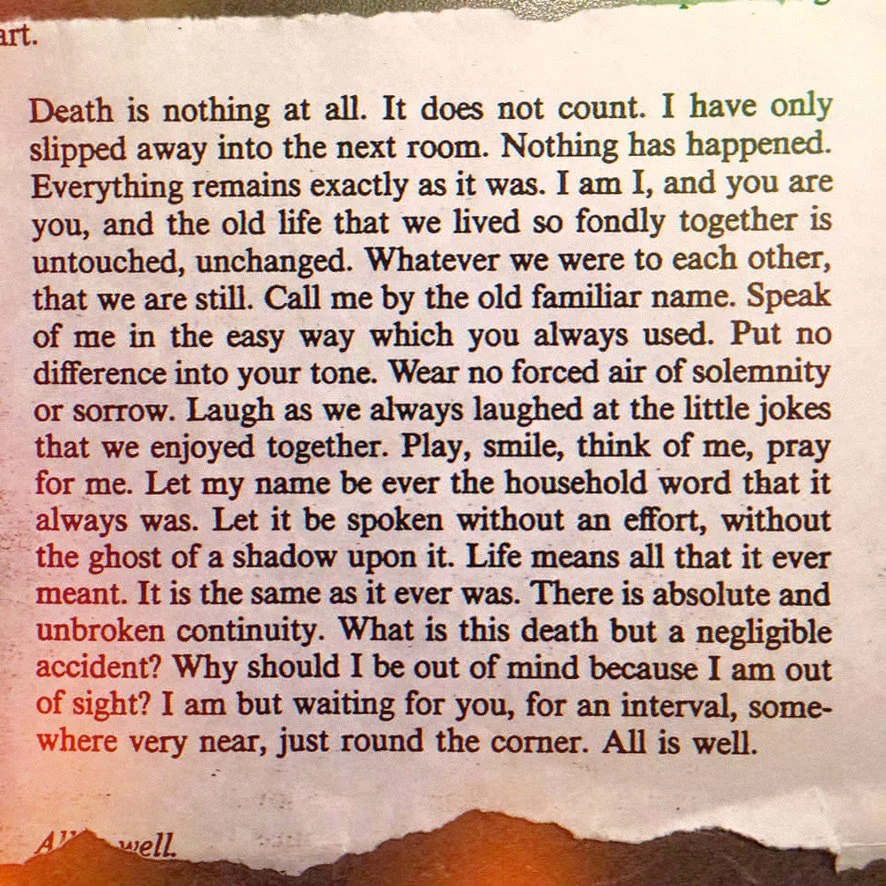
An excerpt from Canon Henry Scott Holland's 1910 sermon, “The King of Terrors.”
Maybe it simply allows us to ask whether physical absence is the only way a relationship can be understood.
We don't necessarily have to decide exactly what these experiences mean.
A psychological interpretation does not have to invalidate a spiritual one. And a spiritual interpretation doesn't require us to reject psychological understanding.
Sometimes we can simply notice.
What did I experience?
What did it awaken in me?
Why did this particular moment matter?
What meaning am I making from it?
Perhaps meaning can exist without certainty.
What If We Became Less Afraid of Death?
One of the ideas I continued thinking about after the workshop was not simply:
What happens when we die?
It was:
How might our relationship with death change the way we live?
Fear of death can easily become fear of living.
We try to control outcomes. We anticipate losses that haven't happened. We postpone experiences. Anxiety asks us to predict what comes next and prepare for every possibility because certainty can feel like safety.
But life has never promised us certainty.
Interestingly, this is where some spiritual practices and psychological approaches can begin speaking a similar language.
Come back to this moment.
Notice what is happening now.
Recognize what you can and cannot control.
Allow uncertainty to exist without immediately trying to eliminate it.
Perhaps that is where contemplation of death becomes unexpectedly life-affirming.
If this life is temporary, how do I want to experience it while I am here?
When an Experience Becomes a Question
Years ago, I wrote about psychospiritual development and the ways that mystical experiences, grief, loss, and other moments that disrupt our ordinary understanding of life can become catalysts for deeper questioning.
Sometimes something happens that doesn't fit neatly inside the framework we've been using.
A dream.
A loss.
A moment in nature.
An experience during meditation.
A synchronicity.
A profound sense of connection.
A moment we cannot quite explain.
The question doesn't necessarily have to be:
Was this real?
Maybe another question is:
What did this experience open in me?
That distinction matters.
Spiritual exploration does not always have to be a search for proof. Sometimes an experience becomes meaningful because it changes the questions we are willing to ask.
And sometimes those questions become part of our development.
Curiosity Without Certainty
There are experiences in my own life that I can understand through a psychological lens.
There are experiences I understand spiritually.
And there are others for which I am perfectly comfortable saying:
I don't know.
I increasingly believe there is something valuable about that position.
Not knowing does not make an experience meaningless.
Curiosity doesn't require certainty.
And spirituality doesn't necessarily require us to stop questioning.
In fact, questioning may be part of how a spiritual life develops.
We can wonder about consciousness and still respect the limits of what we know. We can find comfort in spiritual ideas without presenting them as universal truths. We can experience synchronicities without needing to convince another person what they mean.
We can simply remain open.
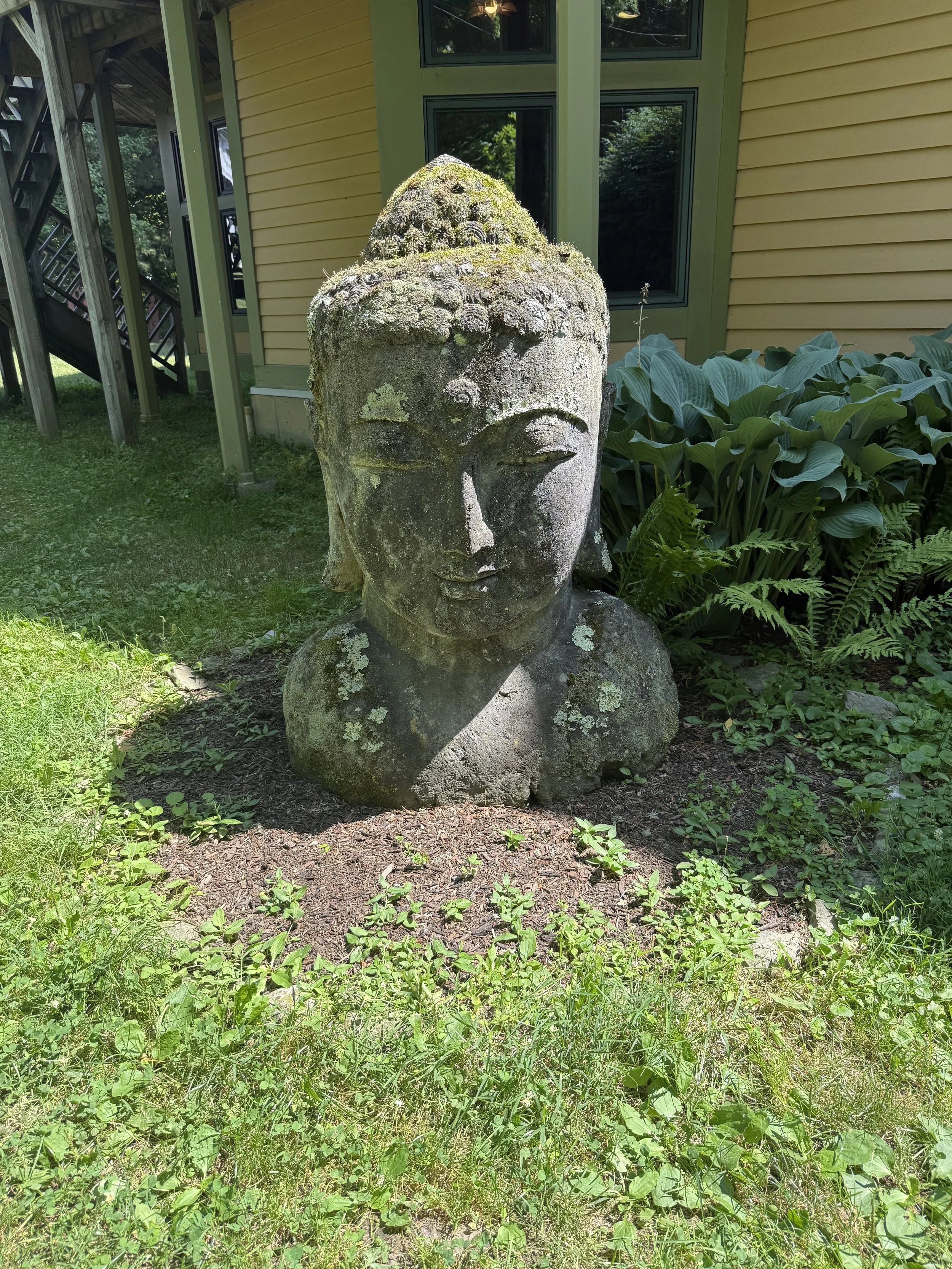
Buddha at Omega Institute
Maybe We Don't Need the Answer
I left the workshop with more questions than answers.
I think that's a good thing.
Perhaps healing doesn't require us to decide exactly what we believe about reincarnation, consciousness, past lives, or what happens after death.
Perhaps contemplating death can instead turn our attention toward something much closer:
Life.
The people we love.
The relationships that need tending.
The things we've been postponing.
The beauty we overlook because we're moving too quickly.
The ordinary moments we assume we'll have an endless supply of.
And perhaps even the extraordinary privilege of simply being here.
My earlier exploration of psychospiritual development focused on the journey, the experiences that awaken us, the questions that follow, the searching, the resistance, and eventually, integration.
I find myself returning to that idea now.
Maybe spiritual development isn't about accumulating increasingly extraordinary experiences.
Maybe, eventually, it brings us back to the ordinary ones.
A conversation.
A breath.
A loss.
A relationship.
Sunlight reflecting on water.
Leaves changing with the season.
The awareness that this moment is happening once, and that somehow, inexplicably, we are here to experience it.
Perhaps we don't need to understand the mystery completely.
Perhaps part of living is learning how to stand inside it.
And perhaps healing sometimes begins there:
not with an answer, but with the courage to remain curious.