
A personal reflection on psychospiritual development, faith, doubt, and learning to experience the sacred in ordinary life
Years ago, I wrote about psychospiritual development and what I called the journey of the soul.
I explored the possibility that spiritual development, much like psychological development, may unfold throughout our lives. I wrote about mystical experiences, vivid dreams, suffering, loss, existential questioning, resistance, and eventually integration: the process of taking whatever we have encountered and learning how to live differently because of it.
At the time, I wrote about those ideas mostly conceptually.
What I didn't write about was one of the experiences that started those questions for me.
I was eighteen or nineteen when my great-grandmother visited me in a dream. At least, that is one way of telling the story.
Another is that I simply dreamed about my great-grandmother, who had been dead for more than ten years.
I think both versions are allowed to exist.
The Dream
My great-grandmother died during my first year living in the United States.
I was young, and I don't remember experiencing her death as some enormous grief. I don't remember crying much.
She died.
Life continued.
And eventually, more than a decade passed.
Then one night, I was back in Venezuela.
I was back in Galipán, on the land where my great-grandmother had lived. Even now, I can picture her house, the simple walls, the land surrounding it, the tanque nearby, and the mango trees.
It was a place belonging not only to my childhood, but to another part of my life entirely:
Venezuela.
Family.
Memory.
And a woman I had lost years before.
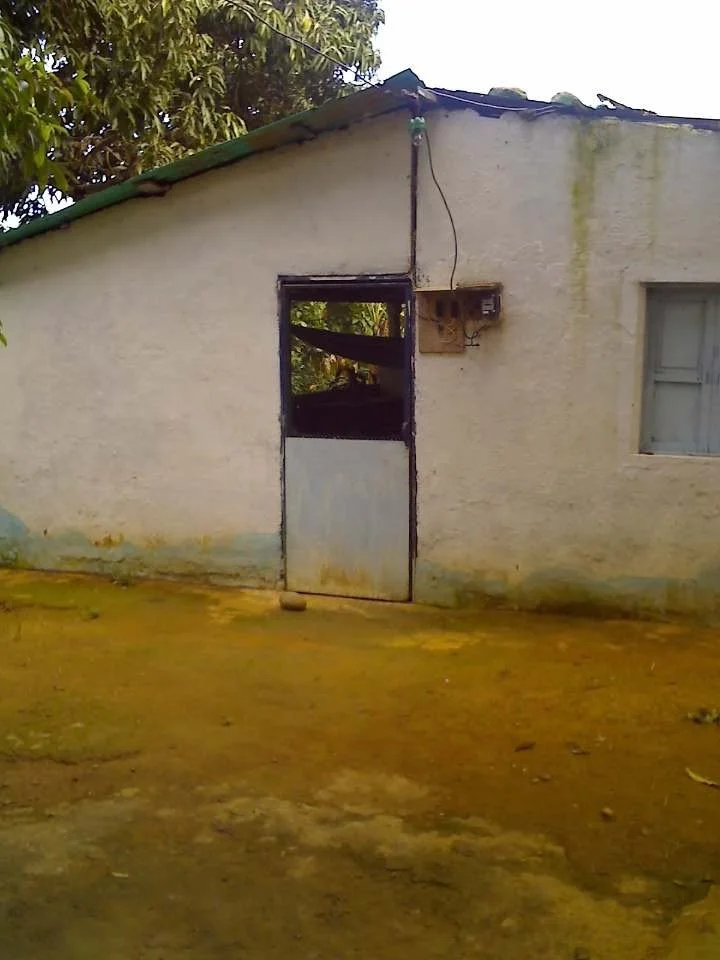
My great-grandmother's home in Galipán, Venezuela.
In the dream, I was sitting near the tanque, the little pool I remembered from her home.
And she was there.
She was shuffling tarot cards.
I remember asking her about my brother Carlos. I wanted to know whether he was going to be okay. I was worried about him.
But rather than giving me the reassurance I was looking for, she turned the question toward me.
Why are you so worried about your brother?
What about you?
Live your life!
I don't remember every word anymore. Dreams don't usually give us transcripts.
But I remember the feeling.
And I remember the end.
She got up and began walking away from the tanque, down toward her house.
Suddenly, I didn't want her to leave.
I was crying.
It was as though grief that had somehow remained inaccessible to me for more than ten years had finally found somewhere to go.
Then I woke up.
And I was shaken, in tears.
When an Experience Becomes a Question
Was my great-grandmother actually communicating with me?
Was my unconscious finally processing a loss I hadn't processed years earlier?
Was my mind using someone meaningful from my past to communicate something I needed to hear about my life in the present?
Was it simply a dream?
I don't know.
And strangely, I don't think I need to.
What mattered was that the experience sparked something in me.
It left me with questions.
Questions about death.
About consciousness.
About God.
About meaning.
About why we are here.
About whether there is something beyond what we can immediately see or understand.
Looking back, I can recognize this as part of what I would eventually come to understand as psychospiritual development.
I didn't suddenly find answers.
I started searching.
Searching for Meaning
One of the books I eventually encountered was Viktor Frankl's Man's Search for Meaning.
And then one book became another.
I became interested in Buddhism. I read about spiritual traditions and philosophies outside the religious framework in which I had been raised. I became curious about different ways human beings across cultures and generations had attempted to answer essentially the same questions:
Why are we here?
What gives life meaning?
What do we do with suffering?
What happens when we die?
And how are we supposed to live knowing that we will?
The more I learned, the less interested I became in finding one perfect answer.
Instead, I became interested in the search itself.
When God Becomes Complicated
My relationship with the word God has not always been simple.
There were periods when I questioned whether I believed in God at all.
I had been raised within a religious tradition, and as I grew older, some of what I had been taught no longer fit comfortably. There were things about organized religion I questioned. There were institutions and interpretations I struggled with.
For some time, I think those questions became tangled together.
If I questioned religion, did that mean I was questioning God?
If I disagreed with an institution, did that mean I had lost faith?
If I couldn't accept everything I had been taught, what exactly did I believe?
There is a phrase we hear often: spiritual but not religious.
For me, that distinction became meaningful at the time.
Eventually, I began to understand that questioning an institution wasn't necessarily the same thing as rejecting the sacred.
Maybe I wasn't walking away from faith.
Maybe I was trying to understand what faith actually meant to me.
Faith Without Certainty
I used to think about faith in very literal ways.
I remember imagining something almost ridiculous:
If I'm falling down a hill and I yell, God, please help me, saying those words doesn't mean a hand is suddenly going to reach out of the sky and stop me from falling.
So what does it mean to have faith?
Over time, my understanding changed.
Faith became less about expecting God to prevent difficult things from happening.
It became something that could anchor me while difficult things were happening.
Something larger than certainty.
Something I could return to when I didn't have an explanation.
And perhaps most importantly, something I could experience rather than simply define.
I became more comfortable using the word God again.
But the God I returned to was not necessarily identical to the God I had questioned years earlier.
Maybe that's part of spiritual development too.
Sometimes we inherit a faith.
Then we question it.
Sometimes we dismantle parts of it.
And eventually, if we choose, we build a relationship with the sacred that feels genuinely our own.

From Extraordinary to Ordinary
When I was younger, spiritual experiences seemed extraordinary.
A vivid dream.
A strange connection.
An experience I couldn't explain.
What some might call a coincidence and what I am more inclined to think of as synchronicity, as coined by Carl Jung.
Those moments still matter to me.
But something has shifted.
The older I get, the less I need spirituality to announce itself dramatically.
Sometimes it looks like nature.
Sometimes it's silence.
Sometimes it's an unexpected moment of connection.
Sometimes it's gratitude.
Sometimes it's simply paying enough attention to realize that I am here.
A few weeks back, I had one of those moments.
I was driving through Warwick on my way into the city. It was October 1st, and the landscape had begun its transition into fall.
The leaves were changing.
I passed a lake and saw sunlight reflecting across the water.
And something about it stopped me internally.
Not physically, I was still driving, but for a moment everything else became quieter.
I felt tears come to my eyes.
I remember thinking:
Oh my God.
How fucking blessed. How grateful.
I get to see this.
I get to experience this.
I get to be here.
Maybe This Is Integration
In my earlier piece about the journey of the soul, I wrote about integration.
Spiritual development isn't simply collecting extraordinary experiences.
If those experiences mean anything, eventually they have to come home with us.
Into our relationships.
Into the way we respond to difficulty.
Into the way we care for ourselves.
Into how we treat other people.
Into how present we are for our families, our friends, our communities.
Into the way we experience an ordinary morning.
Integration asks:
What am I doing with what I have learned?
And perhaps that is where my understanding of spirituality has changed the most.
At nineteen, I was asking enormous questions about the meaning of life.
I still have enormous questions.
But I am less convinced that their answers exist somewhere far away from me.
Sometimes meaning is incredibly ordinary.
It is sunlight on water.
It is watching seasons change.
It is remembering someone who died decades ago.
It is loving people while knowing we cannot keep them forever.
It is surviving something we once thought we couldn't survive.
It is noticing a moment of beauty before it disappears.
It is recognizing that our lives are temporary and deciding to participate in them anyway.
The Questions Didn't Go Away
Psychospiritual development has not given me certainty.
If anything, it has made me more comfortable with mystery.
I still have questions about God.
About death.
About consciousness.
About synchronicity.
About what happens to the people we love when their bodies are no longer here.
About why certain experiences enter our lives when they do.
I don't think spiritual maturity requires pretending we know things we cannot know.
Maybe it asks something different of us.
To stay curious.
To remain open.
To question inherited beliefs while remaining willing to discover what still feels sacred.
To recognize that psychological and spiritual understandings don't always have to compete.
And perhaps to allow experiences to transform us without requiring that everyone else interpret them the same way.
My dream about my great-grandmother happened many years ago.
I still can't tell you exactly what it was.
But I can tell you what it did.
It made me grieve.
It made me question.
It made me search.
And somewhere along the way, all of that searching began bringing me back to something remarkably simple:
being here.
Being awake enough to notice.
Being grateful enough to receive what is in front of me.
Being grounded enough in faith to know that I will not understand everything that happens in this life.
And being curious enough to keep asking anyway.
Maybe the journey of the soul isn't about arriving somewhere else.
Maybe it is about becoming more fully present for the life we're already living.
And maybe sometimes the questions that send us searching are ultimately the same questions that bring us home.