
Boundaries Are Not the Opposite of Love
There is a moment many people miss when it comes to boundaries.
It usually does not happen when someone asks something unreasonable.
It happens in the quiet moment after we already said yes.
The body tightens.
The mind starts calculating time, energy, emotional labor, and what now has to be sacrificed to make this happen. And underneath the commitment, anxiety or resentment slowly begins to build.
This is often the moment we overlook.
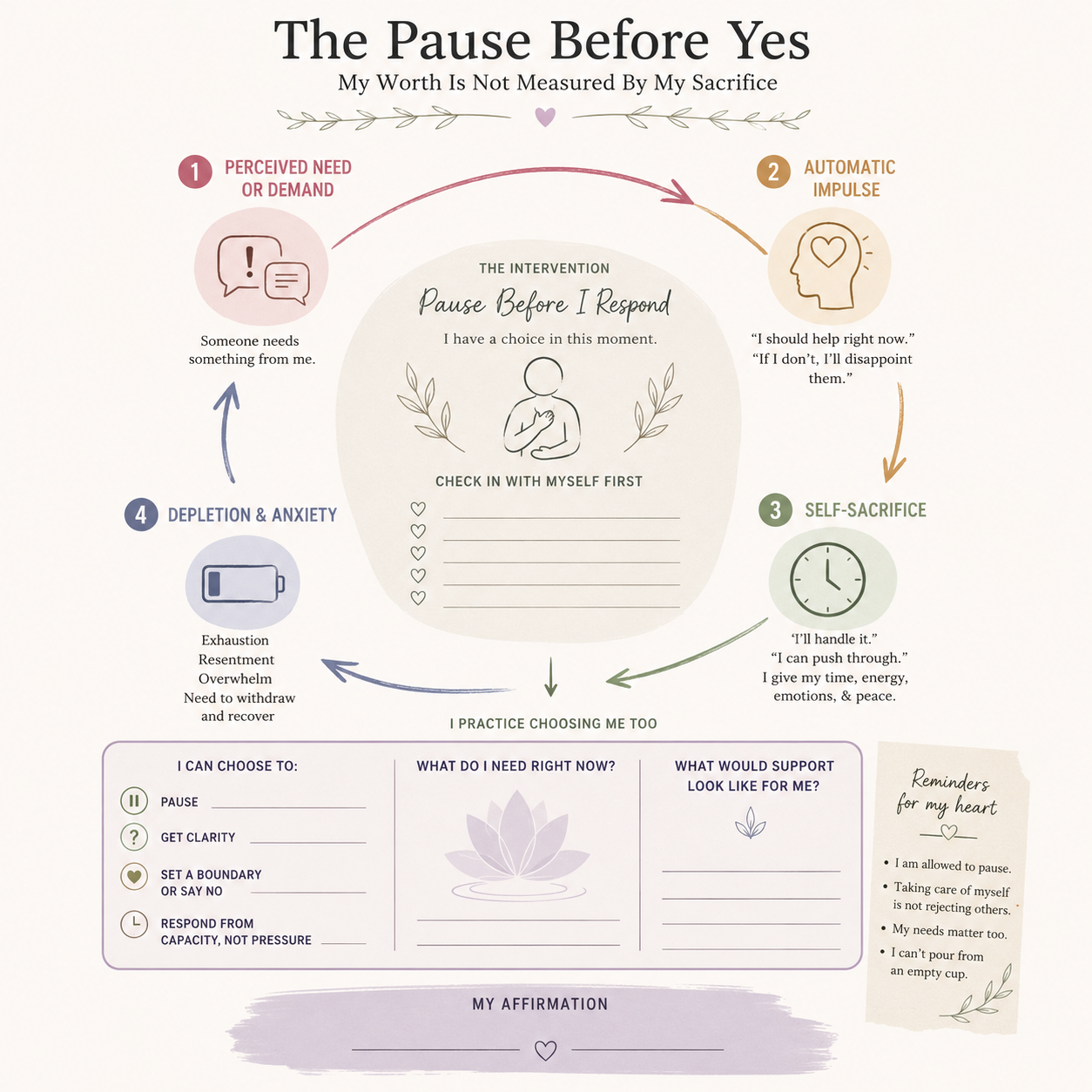
Many people who struggle with boundaries are not selfish or uncaring. In fact, they are often deeply compassionate people who instinctively move toward helping others. The challenge is not a lack of love. The challenge is responding to others while disconnecting from their own capacity.
Sometimes the automatic “yes” is driven by care.
Sometimes it is driven by fear:
fear of disappointing others,
fear of conflict,
fear of rejection,
or the belief that being needed gives us value.
Over time, this pattern creates emotional depletion. We may notice:
exhaustion after helping,
needing isolation to recover,
anxiety,
resentment,
difficulty keeping commitments to ourselves,
or feeling emotionally stretched too thin.
One question I often encourage people to explore is:
“What happens inside of me when I pause before saying yes?”
That pause is important.
Because boundaries are not about becoming cold, distant, or unavailable. Healthy boundaries help us remain connected to others without abandoning ourselves in the process.
One practice I sometimes use with clients is a “Pause Before Yes” reflection tool. The goal is not to immediately say no. The goal is to create enough space to check in with ourselves before automatically committing our time, energy, or emotional capacity.
Before responding, try asking yourself:
Do I actually have the capacity for this right now?
What will this cost me later?
Am I responding from care or from guilt?
What commitment to myself will I have to break to say yes here?
If I give myself permission to pause, what emotions come up?
Sometimes the healthiest response is not an immediate answer.
It may sound like:
“Let me think about it.”
“I need to check my schedule.”
“I want to support you, but I don’t have the capacity right now.”
“I can help in a different way.”
Learning boundaries is not about loving others less.
It is about learning not to disappear from your own life while caring for everyone else.
And often, one of the biggest signs that a boundary was needed is this:
You said yes… but afterward, you felt depleted, resentful, or disconnected from yourself.
That feeling is not failure.
It is information.
And awareness is where change begins.